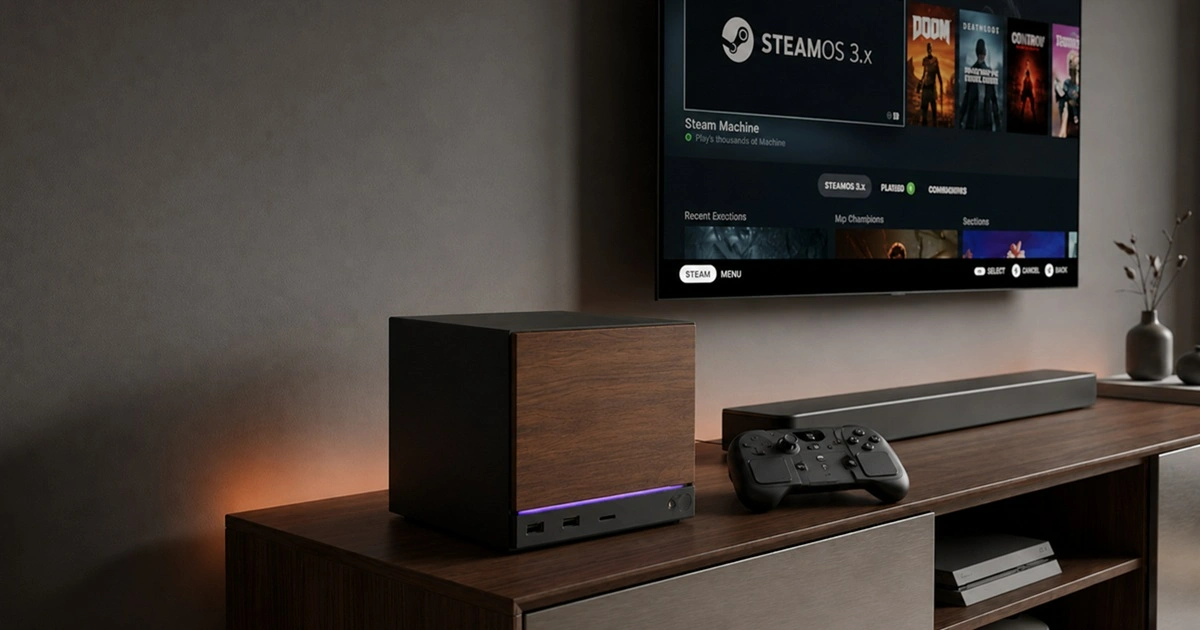
The 2026 Steam Machine has finally arrived with a staggering $1,049 starting price that has hardware purists furious, yet its unmatched plug-and-play living room experience and massive built-in library make it an undeniable must-buy that is selling out fast.
When we last covered the Steam Machine, it was mostly built on hype, leaks, and a grand promise from Valve to reclaim the living room. Fast forward to today, and the wait is finally over: the 2026 Steam Machine officially launched on June 29.
The reviews are pouring in, and the gaming community finds itself in a bizarrely contradictory state. Enthusiasts are absolutely raging about the sticker shock, yet the reservation queue is packed. So, how did Valve manage to build a device that makes our wallets weep but still feels like an absolute must-buy? Let’s look past the marketing and break down the hard technical reality.

The $1,049 Elephant in the Room
Let’s rip the band-aid off right now: this is not a $400 console alternative. Price is the defining headline of this launch. Here is the official retail structure for the initial rollout:
| Model Tier | Storage Capacity | Included Accessories | Retail Price |
|---|---|---|---|
| Base Tier | 512GB NVMe SSD | Console Only | $1,049 |
| Base Bundle | 512GB NVMe SSD | Steam Controller 2.0 Bundled | $1,128 |
| Enthusiast Tier | 2TB NVMe SSD | Console Only | $1,349 |
| Enthusiast Bundle | 2TB NVMe SSD | Steam Controller 2.0 + Walnut Faceplate | $1,428 |
Valve isn’t just trying to pad its profit margins; the system is a victim of a brutal global component crisis. The ongoing AI infrastructure boom has completely devoured the market’s supply of high-density memory, driving the baseline costs of RAM and SSDs through the roof.
Because Valve refuses to heavily subsidize hardware like Sony or Microsoft (who recoup losses via mandatory online subscriptions and a 30% cut of closed-ecosystem digital game sales), that raw component cost gets passed directly to the consumer.
Under the Hood: Spec Sheet vs. Real-World Value
Hardcore PC builders were quick to criticize the spec sheet on paper, noting that the raw parts don’t seamlessly add up to a $1,049 DIY PC. However, looking at the architectural choices reveals what Valve is actually aiming for:
-
Processor: Semi-custom AMD Zen 4 APU (8 Cores / 16 Threads).
-
Graphics: Custom RDNA 3 architecture (roughly matching desktop RX 7600/7600 XT performance).
-
Memory: 16GB DDR5 RAM. Note: Early teardowns confirm this is a single-stick configuration, which drew immediate fire from hardware purists worried about memory bandwidth bottlenecks.
-
Operating System: SteamOS 3.x (Arch Linux-based).
What This Translates to in the Living Room
You aren’t getting native, unassisted 4K at 120 FPS for a thousand dollars. Instead, Valve designed this machine to be the ultimate 1440p Target Device.
By leveraging system-level AMD FSR 3 (FidelityFX Super Resolution) and Valve’s proprietary Proton translation layer, the Steam Machine comfortably runs modern AAA titles at High/Ultra settings at 1440p, scaling beautifully to 4K displays at a locked 60 FPS. It delivers a level of graphical fidelity and frame-rate stability that current-gen consoles hit only in highly compromised “Performance Modes.”
Why the Steam Machine is a Long-Term Value “Must-Buy”
If you judge the Steam Machine purely on a price-to-teraflop ratio, you miss the entire value proposition. The math shifts drastically when you look at the total cost of ownership (TCO) over a five-year gaming generation.
1. The Death of the “Console Tax”
While a traditional console chip is cheaper upfront, it locks you into a paid ecosystem.
-
Multiplayer Fees: Over 5 years, paying $80/year for PlayStation Plus or Xbox Game Pass Ultimate adds $400 to the true cost of those consoles. The Steam Machine features completely free online multiplayer.
-
The Game Pricing Disparity: Steam’s open marketplace means you aren’t locked into a single digital storefront. Between aggressive Steam Sales, Humble Bundles, and third-party key retailers, games are routinely 30% to 70% cheaper than their console counterparts at launch and over time.
2. Immediate Day-One Backlog Integration
If you buy a next-gen console, your existing library is limited by whatever backward compatibility program the manufacturer allows. The moment you log into the Steam Machine, your entire 10-to-15-year backlog of PC games is instantly available on your TV.
3. Absolute Zero Friction
PC gaming on a TV has traditionally been a clunky nightmare of heavy towers, wireless keyboards on laps, erratic Windows updates, and HDR handshake failures. SteamOS 3 provides a seamless, controller-first interface that boots up faster than a Nintendo Switch. You get console simplicity without sacrificing PC freedom.
The Enthusiast Dilemma: Can You Upgrade It?
The primary reason enthusiasts are willing to stomach the entry cost is long-term viability. Unlike traditional consoles, Valve has deliberately leaned into a semi-open hardware philosophy:
Early documentation confirms that while the custom AMD APU is soldered to the board, the storage and memory are completely user-accessible. That controversial single-stick 16GB DDR5 RAM configuration can be easily paired with a second stick to unlock dual-channel bandwidth.
Furthermore, the M.2 2280 NVMe slot is entirely unprohibitive, letting you expand your storage down the line when component prices normalize.
Final Verdict: Bridging the Ultimate Divide
The Steam Machine is a financially polarizing device for those who only evaluate raw hardware sheets. But for the core gaming audience, it solves a decade-long problem.
It eliminates the technical friction of PC gaming while breaking the restrictive, monetized walls of modern consoles. It might hurt to swipe your credit card upfront, but the moment you sit on your couch and experience your massive Steam library running flawlessly on a premium home theater footprint, the sticker shock fades into the background.