In late 2025 into 2026, the tech industry entered what many analysts are calling a memory crisis—a period marked by severe shortages of RAM (random-access memory) components and an unprecedented price hike in RAM that’s rippling through PC makers, phone manufacturers, and consumers alike. The effect is far more than a price sticker change: we are witnessing a structural shift in the global memory market that threatens to reshape pricing, supply, and innovation for years.
For anyone planning to buy a new PC, laptop, handheld console, or smartphone, or upgrade key components this year, the impact will be felt directly in your wallet. In this article, we’ll walk through the root causes of the memory shortage, why prices are rising so fast, how manufacturers are reacting, what it means for you, and practical steps you can take to navigate this turbulent moment.
1. The Global RAM Shortage: What’s Really Happening
The current situation isn’t just a seasonal fluctuation or a minor supply disruption—it’s a structural shift in the semiconductor memory market driven by demand that far outpaces supply.
Why RAM is in Short Supply
Several major forces have converged to create this crisis:
-
Memory manufacturers have cut down production of standard DRAM and DDR5 in favor of specialized memory used in AI and high-performance computing.
-
Artificial intelligence (AI) data center growth is consuming huge quantities of memory chips, especially high-bandwidth memory (HBM) and server DDR5, reducing what’s left for consumer markets.
-
Major brands like Samsung, SK Hynix, and Micron control most of the RAM market, meaning supply constraints affect the entire industry.
-
DDR4 production is being phased out, squeezing the supply available for budget and legacy devices.
These trends have turned what used to be an abundant commodity into one of the most expensive semiconductor components in recent memory.

2. The Price Hike in RAM: How Much Have Costs Jumped
Historic Surges in Memory Prices
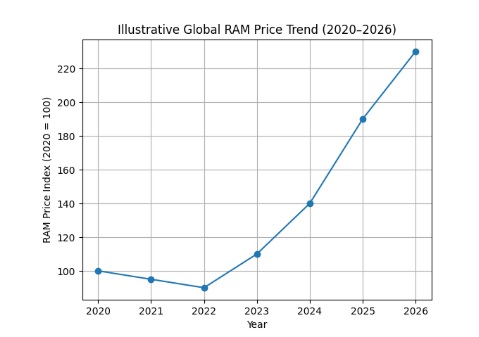
Data from multiple sources shows the scale of the price hike:
-
DRAM contract prices increased up to 50% in late 2025, and could rise a further 40–50% in early 2026.
-
A 64 GB RDIMM memory module soared from about $255 to $450 in one quarter, with analysts warning it might surpass $700 per module by early 2026.
-
Industry reports note that DRAM prices have risen by 171% year-over-year—outpacing many traditional store-of-value assets like gold.
Why This Matters
RAM is one of the core components in every computing device. When RAM prices rise:
-
The bill of materials (BoM) for devices goes up.
-
Manufacturers must either absorb the cost (squeezing profit) or pass it on to consumers.
-
Product launches get delayed or altered with lower specs to hit price targets.
In many cases, the industry is choosing the latter—hence the price hike in RAM trickling down to PC and gadget prices.
3. The Ripple Effect: How Higher Memory Costs Increase Device Prices
The consequences of a RAM shortage and price hike are showing up across the tech ecosystem.
PC and Laptop Prices
Industry forecasts and manufacturer actions clearly show rising prices:
-
Average PC prices are projected to jump 6%–8% in 2026, with some devices increasing upwards of 20% depending on configuration and brand pricing power.
-
Some OEMs, like Framework, have already raised desktop system prices, citing rising LPDDR5x memory costs.
-
Dell, Lenovo, and HP have warned that component price increases will soon affect retail prices.
Example: A desktop that retailed for $1,099 in 2025 might now cost $1,139 or more with no change in hardware other than the memory cost adjustment.
Smartphones and Mobile Devices
Memory costs are also influencing smartphones:
-
Counterpoint Research notes that memory now accounts for a growing share of smartphone production costs—often 10% or more, and rising.
-
Some brands have delayed launches or adjusted configurations to keep prices manageable.
Gaming Devices and Consoles
Gaming platforms and high-performance machines are feeling the crunch:
-
Graphics card and console makers may face higher component costs, especially as VRAM (video memory) also sees price increases due to shared manufacturing capacity with system RAM.
4. Who’s Most Affected? Segments Feeling the Strain
1. Budget and Midrange Consumers
These buyers are hit hardest because:
-
The increase in RAM prices has a larger percentage impact on total device cost when overall specs are lower.
-
Manufacturers are reluctant to cut memory to keep devices competitive, so prices rise instead.
2. PC Gamers and Enthusiasts
Gamers, who often require higher RAM capacities for performance, are seeing:
-
Up to 50% higher prices on memory-dense configurations in certain desktop setups.
-
Delays in new RAM module releases as suppliers prioritize server and AI sectors.
3. Small System Builders and OEMs
Smaller companies without the buying power of Dell or Lenovo are:
-
Stockpiling inventory, which exacerbates shortages.
-
Facing higher component costs, making it harder to compete.

5. Practical Tips: How Consumers Can Navigate Higher RAM Prices
If you are planning to buy or upgrade your tech this year, here’s what you can do:
Tip 1: Buy Earlier Rather Than Later
Since pricing is rising, locking in a purchase sooner may save money, especially for memory modules or complete builds.
Tip 2: Consider Legacy Memory or Platforms
Devices with DDR4 or older memory standards may be cheaper and still perform well for many tasks.
Tip 3: Monitor Spot Market Prices
Spot market pricing can fluctuate daily. Tools and forums (like hardware subreddits) can help track these trends, but always verify with multiple sources.
Tip 4: Evaluate Your Needs Honestly
Ask yourself:
-
Do I need 32 GB or 64 GB of RAM today, or is 16 GB sufficient?
-
Will a slightly older CPU or motherboard model save more in total cost than the RAM price increase?
Tip 5: Prepare for Delays
If you order products with high memory configurations, expect longer delivery lead times due to constrained supply chains.
6. Common Mistakes and Myths About the RAM Price Hike
Here are a few pitfalls to avoid when thinking about this market:
Myth 1: “Prices will snap back once demand stabilizes.”
Reality: Analysts predict shortages may continue into 2027 or beyond, especially if AI demand persists.
Myth 2: “All RAM types are equally short.”
Reality: Next-generation and server-oriented memory types like HBM and LPDDR5X are experiencing the tightest constraints; older DDR4 may still be relatively available in some regions.
Mistake: Waiting for a ‘perfect deal.’
With volatile pricing, waiting too long often means paying more later rather than saving.
7. Real-World Case Studies
Framework Desktop Price Adjustments
Framework, a company known for modular PCs, recently shared that due to high LPDDR5X memory costs, it has raised desktop prices across its line.
Global Price Forecasts
IDC and TrendForce forecasts show average PC prices rising and shipments potentially slowing due to the memory cost squeeze.
Smartphone BOM Shifts
Mobile manufacturers are reportedly adjusting configurations or prices due to memory cost increases, especially in midrange flagships.
8. What This Means for the Tech Industry Long-Term
More Emphasis on Memory Efficiency
Software and hardware designers may prioritize memory-efficient architectures to reduce reliance on expensive memory.
Supply Chain Realignments
Manufacturers are likely to diversify memory suppliers or invest in new capacity to avoid future bottlenecks.
Potential Consolidation in the RAM Market
With fewer players dominating the supply, competition may lessen, keeping prices elevated unless new entrants emerge.
9. Frequently Asked Questions
Q: Will RAM prices ever go down?
A: Analysts suggest prices might not stabilize until 2028 or beyond due to ongoing AI demand.
Q: Should I upgrade my PC now or wait?
A: If your current system suffices, waiting could make sense—but if you need better performance, buying sooner may save you money as prices rise.
Q: Will this affect GPUs and storage?
A: Yes, similar shortages in VRAM and NAND flash are also leading to higher prices on GPUs and SSDs as memory content becomes more expensive.
Conclusion
The global shortage and price hike in RAM is more than a passing headline—it’s a market shift with real implications for consumers and manufacturers alike. With demand driven by AI infrastructure and supply constrained by production shifts and strategic decisions, memory prices have reached levels not seen in years, impacting PC, smartphone, and electronic device pricing across the board.
For consumers, the best strategy is to stay informed, consider your actual performance needs, and act sooner rather than later if you need new tech. For tech watchers and industry observers, this memory crunch highlights how interlinked global supply chains and emerging technologies have become, and how quickly shifts in one segment can ripple through entire markets. Always weigh needs against timing in this volatile environment, and consider memory needs carefully as part of your purchase decision.